Skeleton: Implementation of Double Description Method
Convex Hull Problem and Solving Systems of Linear Inequalities
Home | News | Files | Related Software and Links | Matlab Wrapper

|
Skeleton is a new fast implementation of
Double Description Method (DDM) [1] for generating all extreme rays of a polyhedral cone
and, consequently, for solving the vertex and facet enumeration problems for convex polyhedra.
Using Skeleton you can solve convex hull problem in d-dimensinal space. Also, you can find all
solutions to a system of linear inequalities.
New enhancements [2] make Skeleton very competitive in comparison with other implementations of DDM and other methods for solving these problems. Float, integer and arbitrary precision integer arithmetics is supported. The implementation uses Arageli library for exact computation. Please cite [2] in your publication if you use Skeleton. A descendant of Skeleton is S. Bastrakov's qskeleton that uses a lot of new enchancements [3]. We note that not all features of skeleton is supported in qskeleton.
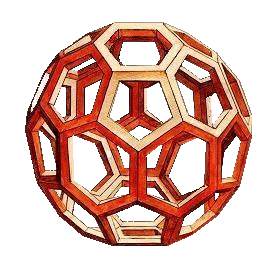
On the figure: truncated icosahedron (soccer ball). This is a Leonardo's drawing called by him Ycocedron Abscisus Vacuus in Luca Pacioli's 1509 book De Devina Proportione. See, for example, Leonardo Page which is a part of George W. Hart's Virtual Polyhedra Pages. |
|
News
22 January 2018Skeleton 02.01r06 is released
14 May 2013
Skeleton 02.01.05 is released
10 June 2012
Skeleton 02.01.04 is released
19 October 2010
Skeleton 02.01.03 is released
15 July 2010
Skeleton 02.01.02 is released
Files
- skeleton.02.00.00.zip
- skeleton.02.00.01.zip
- skeleton.02.00.02.exe.zip
- skeleton.02.00.02.zip
- skeleton.02.00.04.exe.zip
- skeleton.02.00.04.zip
- skeleton.02.01.00.exe.zip
- skeleton.02.01.00.zip
- skeleton.02.01.01.exe.zip
- skeleton.02.01.01.zip
- skeleton.02.01.02.exe.zip
- skeleton.02.01.02.zip
- skeleton.02.01.03.exe.zip
- skeleton.02.01.03.zip
- skeleton.02.01.04.zip
- skeleton.02.01.05.exe.zip
- skeleton.02.01.05.zip
- skeleton.02.01r06.exe.zip
- skeleton.02.01r06.zip
- skeletonman.pdf
Related Software and Links
- Komei Fukuda's CDD: another implementation of DDM
- David Avis' lrs the reverse search algorithm
- pd: Primal-Dual Methods for Vertex and Facet Enumeration by David Bremner, Komei Fukuda and Ambros Marzetta
- Qhull: Quickhull algorithm for computing the convex hull, Delaunay triangulation, etc., floating point arithmetic, by C.B. Barber, D.P. Dobkin, H.T. Huhdanpaa
- Polymake: System dealing with convex polyhedra, simplicial complexes, tight spans, polyhedral surfaces, and other objects by Ewgenij Gawrilow and Michael Joswig
- David Bremner's Discussion of Vertex/Facet Enumeration Software